THE LONG MIDDLE

NEW STORIES EVERY WEEK on substack

mychronicwisdom

https://chronicwisdombymary.substack.com

If you’re finding your way through a life that didn’t turn out the way you imagined, you’re in the right place — this is a space to help you take your bearings when the path forward isn’t clear.

Welcome , I’m glad you found your way here.

There’s a certain moment that arrives when the worst is over — when the doctors are done, the paperwork is signed, the house is quiet again, the future you were living inside has already collapsed. Life keeps moving, but the person you were inside it doesn’t quite come with you.

Sometimes it begins in a body that no longer does what it used to.
Sometimes it begins when a job, a marriage, or a sense of belonging quietly disappears.
Sometimes it begins when the children leave, and just as the house grows still, responsibility returns in the body of a parent who now needs your care.

Different stories. The same strange disorientation underneath.

If something in you recognizes this place, you’re in the right company.

Does this feel like where you are?

When the Dust Settled

My own life stopped making sense in a body that had endured against all expectations. I was shocked, surprised, and not without gratitude to still be here — and at the same time, faced with the fact that staying alive required more adaptation than I knew how to make.

I wasn’t even sure where the boundaries were, let alone how to live safely inside them. What I knew for certain was that the life I had known before was no longer an option.

It wasn’t quiet or graceful.
There was confusion. Self-doubt. Long stretches where I questioned the fairness of it all — why this happened, who it happened to, and what any of it was supposed to mean.

What surprised me wasn’t strength. It was endurance.

Not the kind that looks like courage from the outside — but the kind that keeps showing up inside a life that doesn’t offer clear direction, easy meaning, or a reliable sense of what’s safe anymore.

I studied, researched, and prayed for answers — for direction, for guidance. What I found instead was a wide, frightening emptiness, and the slow understanding that I would have to learn how to stand inside it.

Unsteady Days

At first, I couldn’t even name the place I was in.
Transition didn’t fit. It was too clean, too directional — like moving from one known thing to another. This didn’t feel like grammar school to high school, or a teen becoming an adult. Those words carry a destination inside them.

This didn’t.

There was no sense of where I was headed. No timeline I could point to. No way to tell how long this would last, or how to measure whether I was making progress at all.

I kept wondering what it meant to “rebuild” a life when I couldn’t see the shape of the one I was rebuilding toward.

Days felt experimental. Choices felt provisional.
A constant, low-level wondering about what was safe, what still mattered, and what I could trust myself to hold.

Progress came in small, uneven movements.
Two steps forward.

One step back.

Trial and error.

Long stretches where the only guide I had was a faint, inner sense of what felt right in that moment — and even that shifted from day to day, and at times, moment to moment.

Hope and despair lived side by side, often in the same afternoon.

This is where I began to find a way to orient myself again.

The Map of My Life Had Burned

Not just the plans I had made, but the assumptions underneath them — who I thought I would be, how I believed my days would unfold, what I imagined the future was supposed to look like.

I felt like a survivor standing in the aftermath of a tornado. Everything familiar flattened. No clear direction. No sense of the terrain I was now living inside.

What I wanted was what most of us want when things fall apart: a big picture. A plan. Something to tell me where to begin and how to know if I was moving the right way.

But there was no new map to unfold. No clean set of instructions to follow. Just the open, unsettling fact of being alive in a life I didn’t recognize yet.

So I stopped asking where I was going.
I started asking where I was standing.

Those questions didn’t give me answers.
They gave me a way to take my bearings.

What I didn’t know yet was that the place I was standing in wasn’t just emptiness.
It had a shape — a wide, in-between ground many of us pass through when life changes and doesn’t immediately replace what was lost.

The Long Middle

I eventually found a name for that wide, in-between ground I had been standing on.
I call it the long middle — the stretch of life that opens after something has ended, but before anything new has fully taken shape.

It isn’t the crisis.
And it isn’t the resolution.
It’s the ground most of us live on for far longer than we expect.

In this place, there’s no timeline to follow. No checklist that tells you when you’re “better,” “moved on,” or “back to normal.” Different changes bring people here — illness, divorce, job loss, becoming a caregiver, watching a child leave home — but the questions underneath them start to sound the same.

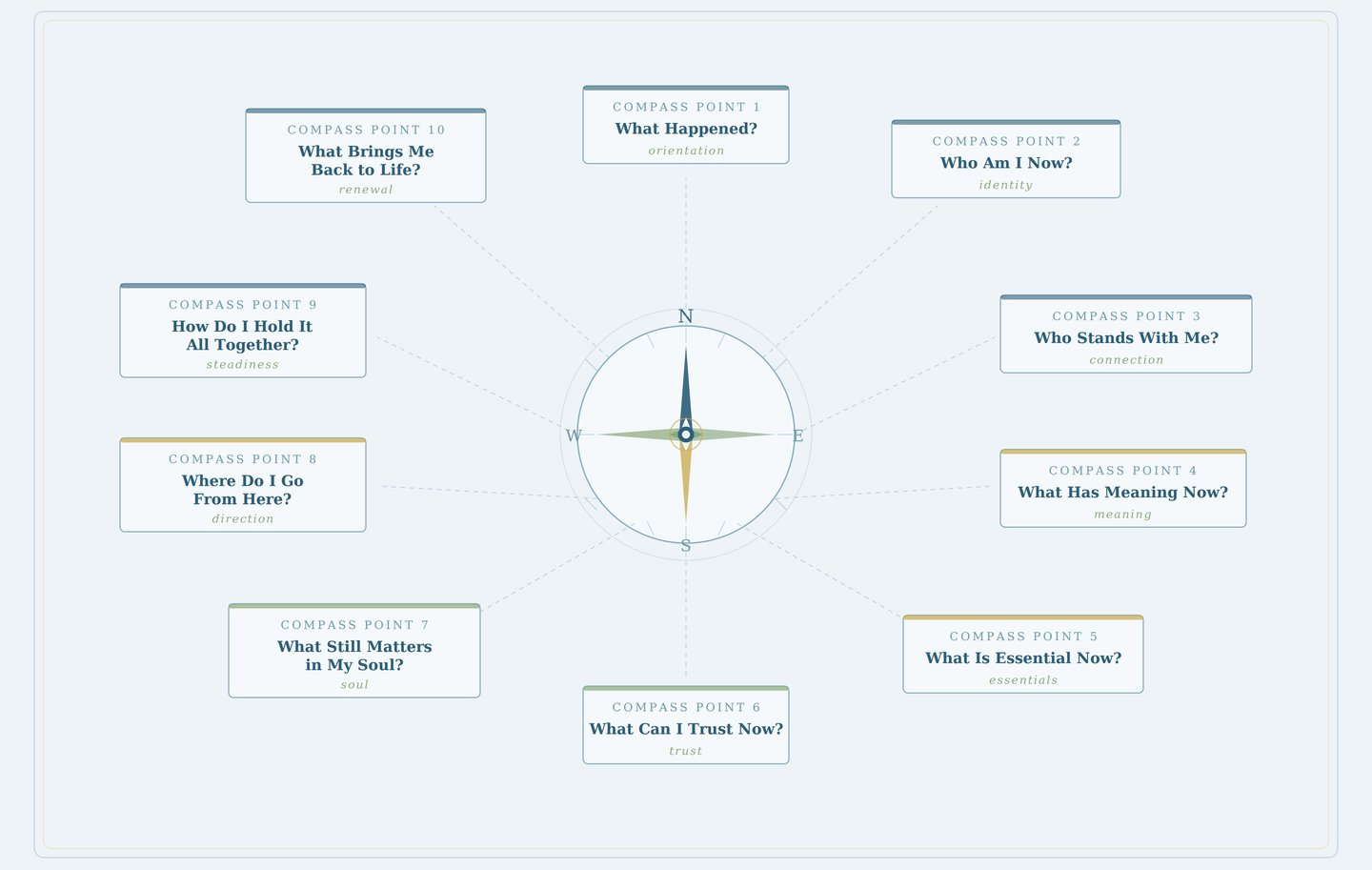
Over time, I noticed a small set of those questions kept returning — the ones I came back to whenever the ground shifted again.

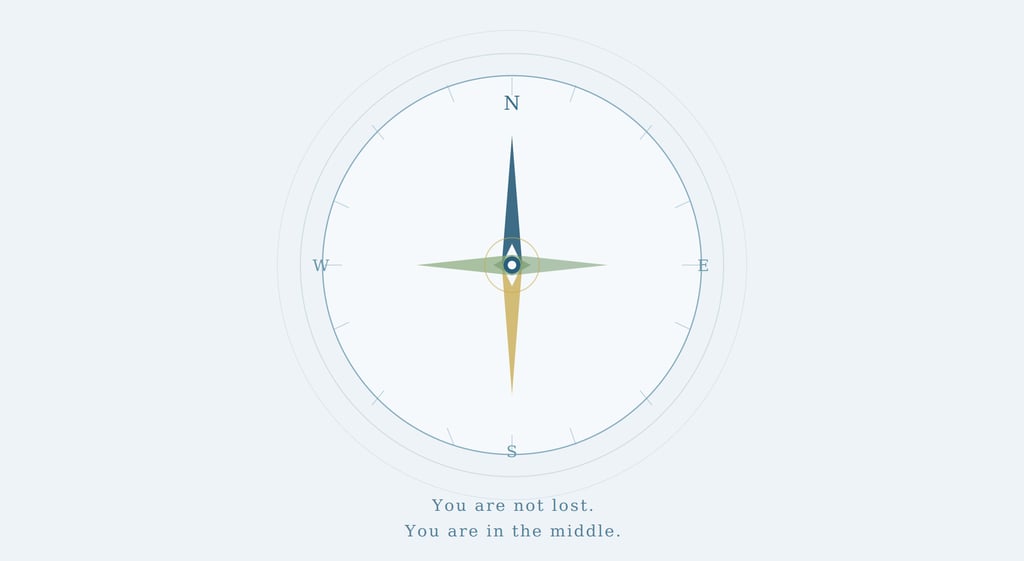
I began to think of them as Compass Points.

Not because they lead you out of the long middle, but because they help you take your bearings inside it — helping you notice what still matters, what you can trust, and what brings you back to yourself, right where you are.

Stay in the Loop

I send occasional updates when new stories, tools, or markers appear — and when something meaningful is taking shape.
No noise. No clutter. Just the work, as it unfolds.