Mary Monoky speaks
Writer • Speaker • Trail Guide in the Long Middle
Living Past the Ending
Living Past the Ending reflects on the disorienting experience of surviving beyond the timeline everyone quietly prepared for. Set within Compass Point 2 — Who Am I Now? — the story follows the strange emotional aftermath of hospice, when the structure of dying disappears but the ability to fully live again has not yet returned. Through quiet reflection and lived experience, it explores suspended identity, survival, and the slow process of learning how to inhabit a future that was never expected to exist.
LIFE TRANSITIONSCHRONIC ILLNESSEMOTIONAL RESILIENCEIDENTITY SHIFTSBODILY UNCERTAINTY
Mary Monoky
Living Past the Ending
Survival does not always feel like relief. Sometimes it is the quiet work of learning how to live inside time that was never expected.
Hospice simplifies life in a way nothing else does.
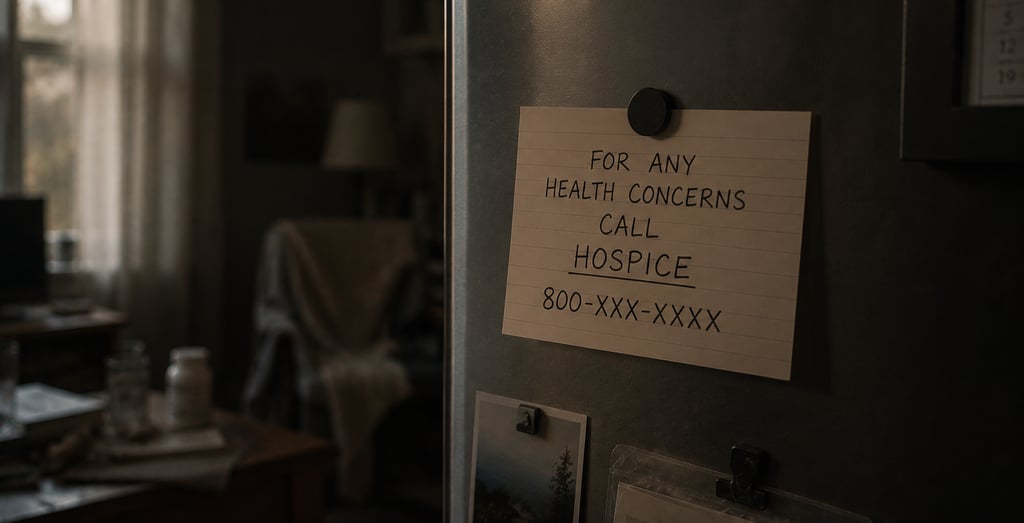
There is one phone number.
One instruction.
One direction.
Call them.
Pain, nausea, fear, confusion — it all goes through that single line.
The goal is no longer improvement.
The goal is comfort.
I understood that agreement when I signed it.
Six months. November through May.
Not a treatment plan — a timeline.
I stopped imagining a future because the future was no longer the assignment.
The work became softer. Slower. Smaller.
Letting go of monitoring. Letting go of hoping. Letting go of fighting.
And then something unexpected happened.
Nothing.
The decline everyone prepared for never quite arrived.
There was no turning point, no recovery story — just the quiet continuation of breath, appetite, and days that did not end.
When hospice ended, there was no ceremony.
The visits stopped. The equipment disappeared. The phone number that once meant safety no longer belonged to me.
And the house went quiet.
It is a strange thing to outlive your own timeline.
Relief does not arrive first.
Bewilderment does.
The body continues, but the mind lingers in the space where life had already been surrendered. The structure of dying disappears faster than the ability to live again.
I remember standing in that quiet wondering what happens next when the plan was never meant to include a next.
There were practical questions — doctors to find, routines to rebuild, ordinary systems that suddenly felt unfamiliar. But beneath the logistics was something more difficult to name.
I did not feel returned to life.
I felt suspended inside it.
People spoke carefully. Some avoided the subject altogether. Others searched my face for evidence of either tragedy or celebration, unsure which language applied to someone who had quietly survived.
Survival unsettles people when goodbye has already begun.
It unsettles you too.
For a while, I lived in smaller circles. Predictable meals. Predictable days. Curtains half drawn. Not out of sadness, but out of orientation — the slow work of learning how to exist without the identity that illness had quietly constructed.
I was no longer dying.
But I was not yet living in any familiar way.
Just learning.
Learning how to move inside time that had reopened without instruction. Learning how to accept help without interpreting it as weakness. Learning how to imagine a future simply because there was now space where one might exist.
It did not feel like triumph.
It felt like trespassing.
But slowly, almost imperceptibly, the quiet shifted from absence to possibility. Not the loud kind. Not the cinematic kind.
The ordinary kind.
A place to rest.
A room that felt safe.
A day that did not require explanation.
That was enough.
Not the return of a life —
but the beginning of inhabiting the one that remained.
This story lives inside Compass Point 2- Who Am I Now ?
© 2026. All rights reserved.
Writing about identity, uncertainty, emotional endurance, and learning to live inside changed realities.