Mary Monoky speaks
Writer • Speaker • Trail Guide in the Long Middle
When the Body Breaks
“When the Body Breaks” explores the moment many people first realize life has fundamentally changed. Through reflection and lived experience, this piece examines physical collapse, uncertainty, fear, and the emotional disorientation that can follow when the body no longer behaves in familiar ways. Located within Compass Point 1 — What Happened? — the story reflects on the beginning of the long middle: the moment the old assumptions about life, health, identity, or stability begin to fracture.
DISRUPTIONBODILY UNCERTAINTYTHE BEGINNING OF THE LONG MIDDLE.
Mary Monoky
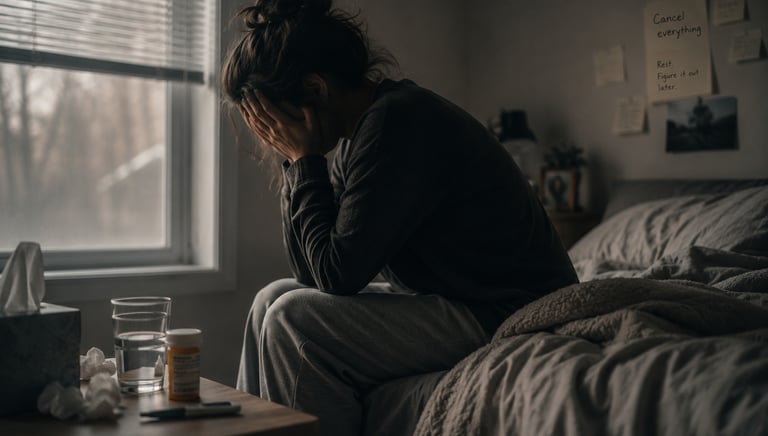
When the Body Breaks.
Excerpt from When the Body Breaks
Before I understood anything about chronic illness, I believed that my body would eventually calm, correct itself, and return me to the rhythm of my old life.
I thought discomfort meant recovery was taking longer than expected.
I thought fatigue was something a good night’s sleep could fix.
I thought pain had a beginning and an end—because that was the only template I had ever seen.
But illness does not always behave that way.
Sometimes the body falters quietly, without an event to point to, and without a clear moment when everything changes. Sometimes it opens a door you never meant to walk through, into a stretch of time where nothing feels familiar and yet nothing announces itself as an emergency.
This is what I call the long middle—
the place between not as bad as I once was
and not as good as I hope to be.
This story comes from the earliest days of that shift, before I had words for it, before I knew what chronic meant, before I realized I was entering a different kind of life.
It begins in the middle of an ordinary week, when I still believed the disruption was temporary, and when I had no idea how long it would take for the truth to surface.
When the body breaks, medicine knows what to do.
There is a protocol for the crash, the crisis, the wound. American medicine excels at the acute—at saving, stitching, and stabilizing.
But once the emergencies quiet down, the system falls silent too.
There is no handbook for the years that follow, for the body that does not die and does not get well.
When I first became sick in the late 1990s, I went searching for one.
I spent afternoons in public libraries, combing medical journals, flipping through indexes, trying to find language for this new terrain I had entered.
Twelve weeks, one journal said.
After twelve weeks, pain is considered chronic.
I remember staring at that sentence, my pulse thudding. I was already past it.
No one tells you what happens after that line.
I felt a chill that had nothing to do with fever.
Short-term disability is familiar to most people.
It is the safety net for a broken leg, a surgery, something you are supposed to heal from. Long-term disability is different. Few people talk about it, and fewer understand what it feels like to need it.
The gap between your last paycheck and the first Social Security Disability payment can stretch for months.
I was terrified.
Bills did not stop because my body had.
Rent was due.
The phone still rang.
The mailbox filled with forms written in a language I did not yet speak.
I was not only losing my health.
I was losing my footing in a world that runs on momentum and employment.
What I did not know back then was that there is a whole world of us living with illnesses that cannot be seen.
Silent, invisible conditions that do not announce themselves but quietly rearrange a life.
No one warned me that the absence of visible evidence would make the burden heavier.
That invisibility could be isolating—not only from others, but from the version of myself I once recognized.
I remember using a disabled parking space at the grocery store, my placard hanging from the mirror.
I had recently come home from surgery. The incision nearly circled my torso, stitched and draining, with pumps and tubing trailing like reminders of survival.
That afternoon, I pushed myself to make one small errand, hoping to feel normal again.
By the time I reached the car, every step burned.
Then I saw it.
Continue reading in the forthcoming book.
This story lives in Compass Point 1 — What Happened?
© 2026. All rights reserved.
Writing about identity, uncertainty, emotional endurance, and learning to live inside changed realities.