Mary Monoky speaks
Writer • Speaker • Trail Guide in the Long Middle
I Felt Her Leave
A reflective story about creativity, loss, and rediscovering the parts of ourselves we thought had disappeared. In He Thought That Part of Him Was Gone, Mary Monoky explores how identity can quietly survive illness, aging, and limitation—and how meaning sometimes returns through the smallest acts of connection. A companion piece to Compass Point 7 — What Still Matters in My Soul?
IDENTITY SHIFTSINTUITION & AWARENESSCAREGIVING & CONNECTIONNARRATIVE NONFICTIONTHE LONG MIDDLEATTACHMENT & CONNECTIONWHAT STILL MATTERS IN MY SOUL?SOUL & PRESENCE
Mary Monoky
5/27/20263 min read
I Felt Her Leave
It wasn’t a voice.
Not a whisper.
Just a shift in the room I couldn’t explain.
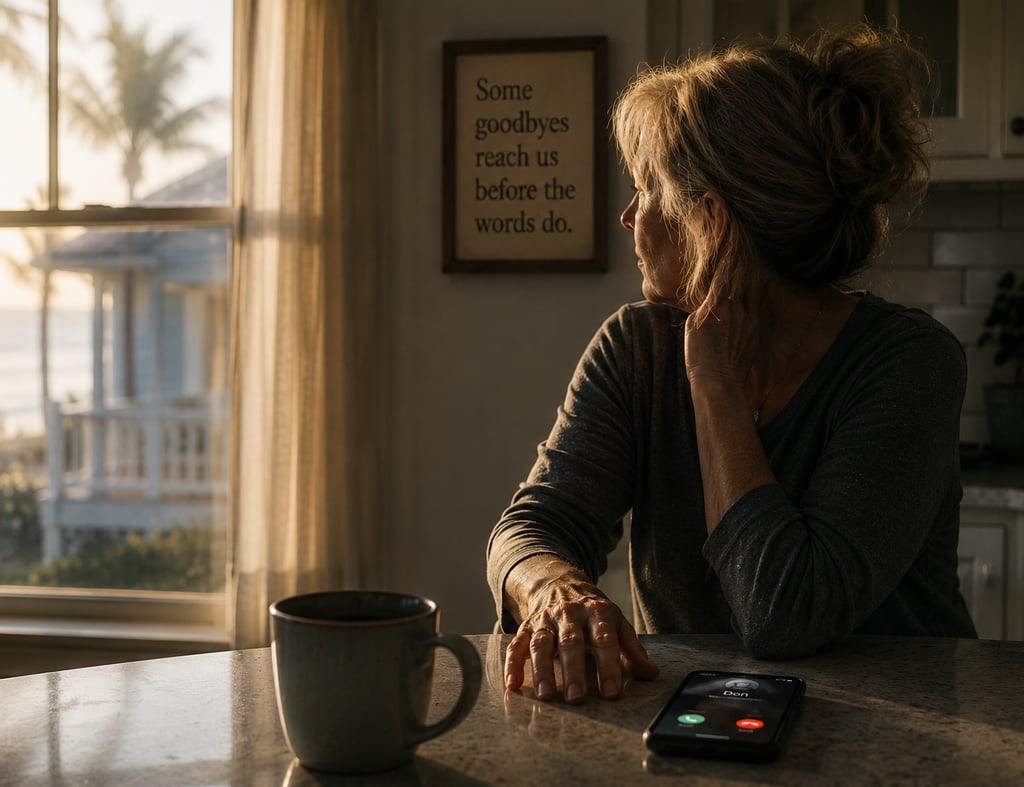
I wasn’t in Florida — not at the beach house where Dot and Don lived just beyond my kitchen window.
I was in New Jersey, on a short trip, far from the beach and everything I once knew.
And yet, that morning, standing in someone else’s kitchen,
coffee cooling in my hand, sunlight stretching across the counter —
and then I felt it.
A hush.
A pause.
The world… stilled.
I didn’t look at the clock.
Didn’t reach for my phone.
I just knew.
Dot was gone.
And hours later, the phone rang.
Dot and Don had been my neighbors for years at the beach house.
But more than neighbors — chosen family.
From the start, they welcomed me in.
Dot was a whiz in the kitchen, happiest when she was feeding people.
Don, strong as an ox, was always close behind — fixing whatever needed fixing, looking after me like an older brother.
Dot was no-nonsense. If something needed doing, she did it.
If something hurt, she worked through it. Complaints weren’t her style.
Don, meanwhile, lived with chronic heart issues that required constant managing.
Quietly, the assumption — spoken or not — was that Don would go first.
Even Dot believed that.
But then her shoulder started hurting.
She brushed it off at first — probably arthritis, maybe a pulled muscle. Nothing worth making a scene over.
Don noticed, though.
The way she avoided reaching up.
The fatigue behind her eyes.
He insisted: “We’re going in.”
What they expected was a diagnosis they could manage.
What they got… was thirty days.
Cancer.
Advanced.
Aggressive.
Dot didn’t argue.
She didn’t spiral.
She faced it.
In one of our last quiet conversations, she said it plainly:
“This is going to be the end. I just know it.”
There was no fear in her voice.
Just clarity.
Don wasn’t ready to hear that.
He clung to hope.
“Maybe another opinion,” he said. “You’re strong. We’ll find something.”
But Dot didn’t spend her final days chasing cures.
She spent them quietly preparing Don to live without her.
That was her goal.
Not recovery.
Release.
To ease him toward goodbye — gently and lovingly — while she still could.
When Don finally called, his voice was low, hollowed out.
“Mary… Dot passed this morning.”
He didn’t say much else. He didn’t have to.
I listened, already holding the weight of it — already carrying the knowing I couldn’t explain.
When I returned to Florida, everything looked the same.
But the air itself felt rearranged.
The street was quieter.
The light felt different.
Dot was no longer just around the corner.
And somehow, the whole block knew.
Here’s what I carry:
Dot didn’t go out fighting.
She went out knowing.
She left with intention, with grace, with love.
She helped Don begin to let go.
And somehow, she helped me feel it too.
Have you ever felt that?
A presence shift before the phone rang, before the words were said?
A quiet knowing that arrives without explanation — only certainty?
It’s strange, the way connection lingers.
How it travels beyond walls, beyond states.
How it tells the truth, softly, to those willing to feel it.
Field Note — The Moment of Knowing
Sometimes knowing doesn’t start in the mind.
It begins in the body — a drop in your chest, a stillness in the air around you, a quiet shift you can’t explain. The body recognizes patterns long before the mind interprets them. It remembers the people who have lived close to us — their rhythms, their nearness, the way their presence feels in a room.
Then the mind steps forward, not with logic, but with recognition.
No facts, no evidence — just the sense that something essential has changed. The mind tries to make sense of it, to match the physical signal to a reason, but some moments aren’t meant to be solved. They’re meant to be noticed.
And beneath both body and mind, the soul understands.
It recognizes when someone we love has shifted from here to elsewhere, from form to essence. That understanding arrives not as fear but as truth — quiet, steady, unmistakable.
When the knowing comes before the call… that isn’t imagination.
It’s connection doing what connection does: moving through the body, interpreting through the mind, settling in the soul.
Love doesn’t vanish when a life ends.
It simply travels differently — and sometimes, if we’re open, we feel the moment it changes shape.
© 2026. All rights reserved.
Writing about identity, uncertainty, emotional endurance, and learning to live inside changed realities.