Mary Monoky speaks
Writer • Speaker • Trail Guide in the Long Middle
The Decade Trip
A grandmother and grandson travel to Iceland for a long-planned “decade trip,” only to find themselves navigating exhaustion, confusion, unexpected kindness, and breathtaking adventure in a foreign country. Set within Compass Point 4 — What Has Meaning Now? — this story explores resilience, wonder, intergenerational connection, and the quiet realization that meaning is often found by continuing forward even when the map no longer works.
MEANING AFTER LIFE CHANGESTRAVEL & TRANSFORMATIONGRANDPARENT STORIESRESILIENCE & REINVENTIONFAMILY & CONNECTIONICELAND TRAVELTHE LONG MIDDLECOMPASS POINT 4NARRATIVE NONFICTIONPERSONAL ESSAYS
Mary Monoky
5/26/20264 min read
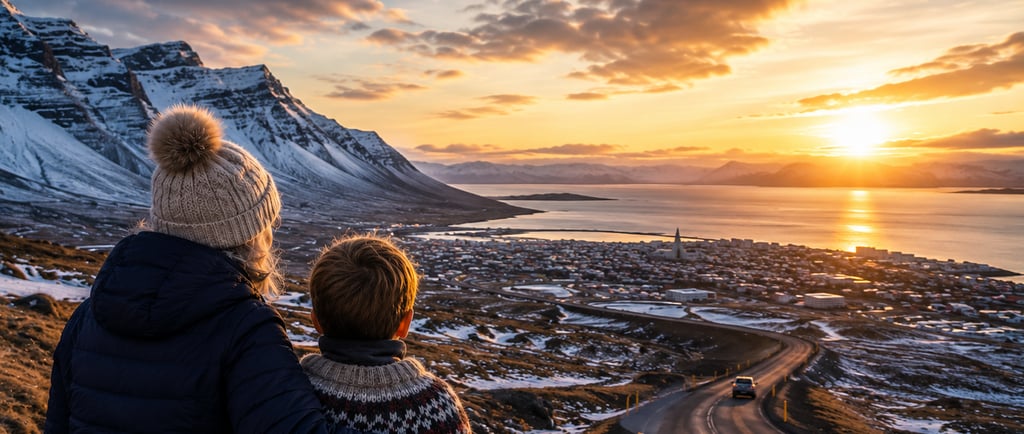
Many years ago, long before any of us three sisters had grandkids, an idea came to us in a hair salon somewhere between coffee sips and hair foils: age ten was the magic number for grandkid adventures. Just the right mix of independence and wonder — able to read a menu, find a restroom, and still hold your hand crossing the street.
That little tidbit stuck with us.
Fast forward. My second grandson turned ten, and it was his turn for the “decade trip.” We were heading from New Jersey to Reykjavik, Iceland. To build excitement, we pre-ordered custom wool sweaters with authentic Icelandic patterns. That stirred his curiosity. He started reading about glaciers and volcanoes, puffins and Viking sagas. We were ready.
Our red-eye flight from Newark landed just before dawn. I’d wisely booked the hotel room for the night before our arrival, knowing check-in wasn’t until 4 p.m. That way, we could go straight from the airport to a nap. At that point, I’d already been awake for twenty-six hours.
The car rental line was glacially slow. One agent, a dozen tired travelers ahead of us. Most airport shops were still closed, the sun hadn’t risen, and my grandson was already drooping. Eventually, the clerk handed me a paper map, a set of keys, and pointed down a hallway.
“Go left,” she said.
We did. No signs. No arrows. Just a long corridor that dumped us into baggage claim. We’d already picked up our suitcases, so we followed the crowd outside, hoping to find a sign, a shuttle, something to tell us where the rental cars were.
Instead, an arctic wind slapped me across the face.
Picture a vast, glittering parking lot under a rising sun — rows and rows of identical cars. No signs. No kiosks. Just wind and confusion.
We ducked back inside to find help. No luck. I tried to call the rental company, but my phone had no service. Around us, other tourists paced like lost penguins, key fobs raised like magic wands, hoping their rental would blink back. We joined the search party.
Lugging our fifty-pound suitcases over the sharp gravel lots, backpacks stuffed with electronics and crumpled snack wrappers, we searched row after row.
Click. Nothing.
Move over a row. Click again.
Finally: beep beep.
A mid-size SUV blinked back at us.
Victory.
My grandson climbed into the back seat and instantly fell asleep. I got in, ready to head to the hotel. I plugged in my phone and realized the GPS wasn’t working. No data. No signal. No directions. The printed map? All in Icelandic.
Great.
Let’s recap: twenty-eight hours awake, a sleeping ten-year-old in the back seat, no phone, no working map, no idea where I was.
But I had wheels.
There was only one road out of the airport. I could go back — or forward.
I chose forward.
I remembered Reykjavik sits along the sea, so I kept the ocean on my left and hoped that would lead me toward town. The plan was to pull into a gas station or store, let my grandson keep sleeping in the locked car, and ask someone for directions.
But there were no gas stations. No stores. No homes. No trees. Just an empty, hauntingly beautiful landscape — the road stretching ahead, the rising sun, and nothing else.
After about an hour, buildings finally appeared on the horizon. I exhaled for the first time in what felt like hours. Street signs began popping up — still unreadable, but at least I knew I was getting close.
Now came the grid search.
I knew the hotel’s name and had the address written on an index card in my wallet. Unfortunately, Icelandic street names and I don’t get along. I drove slowly through the streets, turning left, then right, doubling back, circling blocks. One-way streets and construction zones added to the chaos. No hotel. No open businesses. No one to ask for help.
By noon — six hours after landing and pushing hour thirty without sleep — I gave up. I pulled into a yellow cross-hatched loading zone just to think.
And then, like magic, she appeared.
A young woman walking nearby.
I jumped out of the car.
“Do you speak English?”
“Yes,” she smiled.
I hadn’t realized how close I was to breaking. Her kindness cracked something open in me — my voice caught, my throat tightened.
I could’ve cried.
I quickly explained that my phone wasn’t working, my grandson was asleep in the car, and after thirty-two hours awake I was exhausted, desperate for a bathroom, and completely out of ideas.
Without hesitation, she pulled out her phone, called the hotel, then handed it to me.
“Yes, we’re expecting you,” the front desk told me. “You’re just two blocks away.”
I looked at her.
“Can you help me get there?”
She nodded.
“Follow me.”
She didn’t just give me directions. She gave me back my footing.
Fifteen minutes later we were checked in — my grandson still half asleep, me holding back tears of relief.
Later that week, my grandson was over the moon when we climbed aboard the biggest glacier truck in the world — The Big Red Truck. Riding up the mountainside from Gullfoss into the higher elevations of Langjökull Glacier, we experienced the first snow of the year. We made snow angels, drank hot cocoa, and smiled until our cheeks hurt.
That’s the story of our decade trip.
Iceland was stunning. The sweaters were perfect. And my grandson still talks about the adventure — especially the part where Grandma got lost in a foreign country with no phone, no map, and no clue, but somehow made it work.
Turns out, ten years old really is the perfect age for a trip like that — old enough to remember the adventure, young enough to believe getting lost in Iceland with your grandmother is part of the magic.
The Decade Trip
© 2026. All rights reserved.
Writing about identity, uncertainty, emotional endurance, and learning to live inside changed realities.