Mary Monoky speaks
Writer • Speaker • Trail Guide in the Long Middle
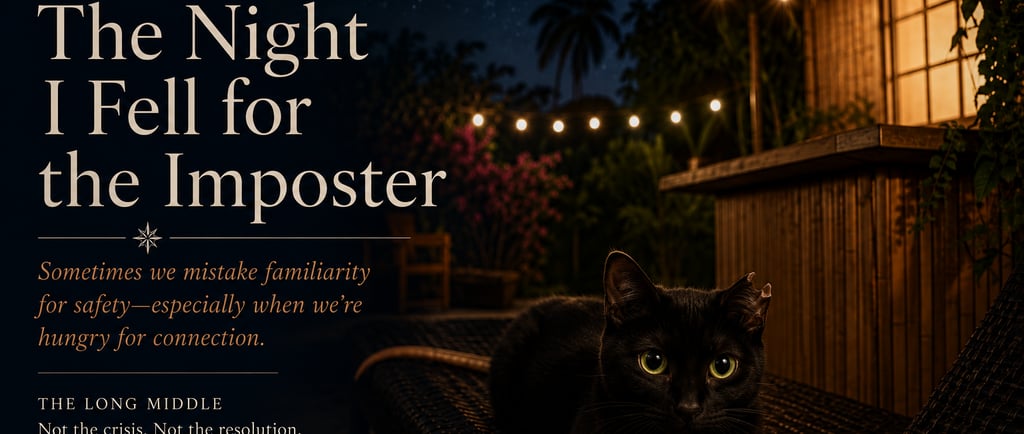
The Night I Fell for the Imposter
A humorous but reflective essay about misplaced trust, emotional pattern recognition, and the human tendency to mistake familiarity for safety. In The Night I Fell for the Imposter, Mary Monoky uses an unforgettable late-night encounter in her Florida garden to explore how hope, loneliness, and longing can blur perception—and how the body often recognizes truth long before the mind is ready to accept it. A companion piece to Compass Point 6 — What Can I Trust Now?
COMPASS POINT 6WHAT CAN I TRUST NOW?SELF- TRUSTLONELINESS & CONNECTIONINTUITION & AWARENESSTHE LONG MIDDLENARRATIVE NONFICTION
Mary Monoky
5/27/20262 min read
The Night I Fell for the Imposter
Living in Florida, winter evenings could feel like small miracles. While the rest of the country shoveled snowdrifts or chipped ice from windshields, I lounged outside in a sleeveless shirt, sipping something cold while a balmy breeze carried the scent of salt and night-blooming jasmine through the yard.
My garden was my refuge—not manicured or polished, but alive in its own unruly way. Bougainvillea tangled into stubborn knots. Sea grape leaves drifted along the fence. Palms hung shaggy and wild. I was slowly coaxing the space back to life, one weed and dead frond at a time.
Tucked into the corner stood my tiki bar. Nothing fancy, but at night, beneath the palms and stars, it felt like a tiny tropical world separate from everything else.
And then there was Baby Cat.
A small black feral with a clipped left ear, she had adopted my garden years earlier and never fully left. Some nights she’d perch on the tiki bar like a tiny panther, silently supervising my work. Other nights she vanished into the darkness for days before returning as if no time had passed at all.
One evening, after working in the yard all day, I stretched out on the chaise lounge, exhausted and happy. The air smelled like damp earth and salt. Stillness settled around me.
Then I felt it.
A small furry head nudging my dangling hand.
I smiled immediately.
Baby Cat.
Eyes closed, I stroked her absentmindedly while the tension of the day slowly drained from my body. Her steady purr grounded me. For a while, it was just the two of us beneath the palms and stars.
Then I heard a sound to my right.
I opened my eyes.
There, perched on the tiki bar in the faint spill of light from the kitchen window, sat Baby Cat.
Watching me.
My brain stalled.
If that was Baby Cat...
...then what exactly was I petting?
Slowly, I looked down.
Not Baby Cat.
A very large opossum.
Reader, I reacted exactly the way you’d expect a six-foot-tall woman to react after unknowingly cuddling a possum in the dark. I launched myself off that chaise lounge like a malfunctioning gymnast, flip-flops flying, arms windmilling, dignity fully abandoned.
The possum barely moved.
If anything, he looked mildly disappointed that our bonding experience had ended so abruptly.
The next morning, I laughed until my stomach hurt.
But underneath the absurdity, something deeper lingered.
I wanted it to be Baby Cat.
That truth landed harder than the embarrassment.
For years, I kept trying to decide whether trust was about intention, chemistry, warmth, or history. But eventually I realized trust has less to do with isolated moments and more to do with patterns.
Patterns tell the truth slowly.
Not through a single conversation.
Not through closeness.
Through repetition.
Living alone, quiet can play tricks on you. You begin recognizing the emotional shapes of things before you fully see them. Sometimes you mistake familiarity for safety simply because you want relief from uncertainty.
I’ve fallen for imposters before. People, promises, versions of reality I wanted badly enough to believe in. Not because I was foolish, but because hope and recognition can sometimes feel dangerously similar.
The body notices patterns long before the mind stops explaining them away.
That may be the real lesson the possum left behind.
Sometimes, fakes unearth truth.
This Story lives inside Compass Point 6- What Can I Trust Now ?
© 2026. All rights reserved.
Writing about identity, uncertainty, emotional endurance, and learning to live inside changed realities.